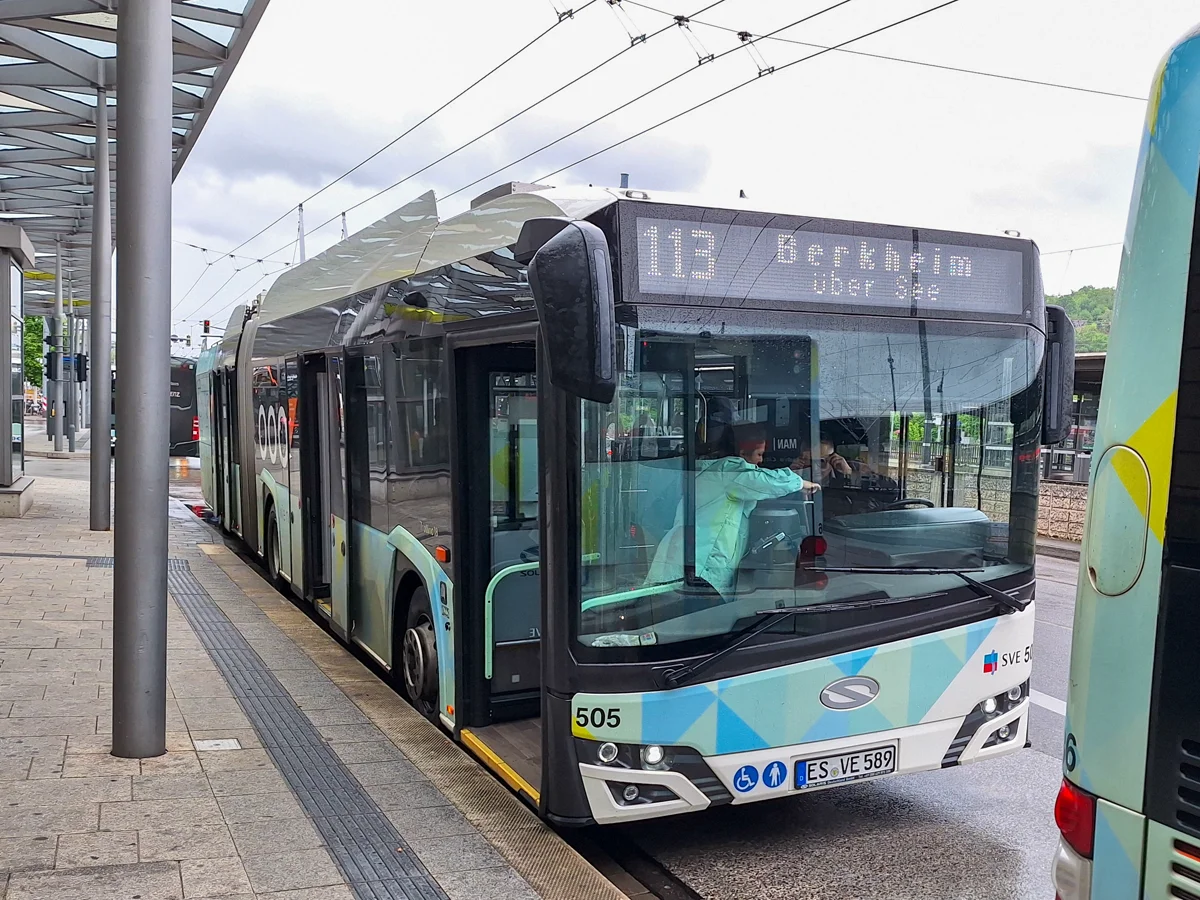

The completed model and reported TRL 5 relate to the underlying T-wire technology. This does not mean that every application described has been tested. Sector-specific integration is a further development step.
New possibilities for public transport
T-wire is an innovative trolleybus power supply system designed to simplify overhead line infrastructure, reduce construction costs and increase flexibility in planning public transport routes.
Unlike conventional solutions, T-wire does not require extensive overhead infrastructure based on a network of exposed contact wires, numerous support poles, tensioning systems and guy wires. This enables trolleybus routes to be developed in a simpler, more flexible and potentially less costly way.
Rapid construction and flexible route design
The T-wire system is designed to enable efficient deployment of power supply infrastructure and adaptation to the existing road network and public transport requirements.
The system’s key capabilities include:
- Simplified infrastructurereducing the need for the extensive components associated with conventional overhead line systems.
- Potential cost reductionsthe potential to reduce infrastructure construction and maintenance expenditure.
- Rapid route deploymentthe potential to bring new trolleybus route sections into service more efficiently.
- Flexible network layoutsthe ability to design line crossings and arrangements that allow vehicles to pass one another.
The T-wire design includes dedicated infrastructure components such as trolleybus line crossings, allowing lines to intersect, and passing sidings, allowing vehicles travelling on the same line to pass one another.
Existing structures and new route options
The use of existing structures, such as lighting poles, is assessed after checking their load capacity and installation conditions. The aim is less complex infrastructure and potential reductions in construction and maintenance costs.
We have designed a crossing that allows trolleybus lines to intersect.
We have designed a siding that allows vehicles on the same line to pass and supports the organisation of express services.
Functional diagrams — simplified and not to scale.
A second life for electric buses
One potential application of T-wire is the conversion of existing electric buses whose continued operation becomes uneconomic because their traction batteries have deteriorated.
Where the cost of replacing the batteries exceeds the economically justifiable value of the vehicle, converting it for trolleybus operation may be an alternative.
This involves connecting a suitably adapted bus to the T-wire current collector trolley and integrating its power supply system with T-wire infrastructure. Depending on the bus design and the selected technical configuration, this approach may allow continued use of the vehicle without the expense of replacing the entire battery pack.
This offers an opportunity to extend the service life of the existing fleet, reduce demand for new vehicles and make more effective use of previous capital investment.
Economic efficiency and environmental benefits
The potential to convert used electric buses supports a circular economy and responsible use of resources. Rather than retiring a vehicle prematurely because its batteries have deteriorated, operators can consider adapting it to a different power supply method.
This approach may reduce waste associated with premature vehicle retirement, reduce the need to manufacture new buses and enable better use of the existing fleet.
T-wire — flexibility in designing the transport of tomorrow
T-wire is a concept for overhead line infrastructure combining the potential for a simpler power supply system with flexible route design and the reuse of electric buses.
The aim is to create new opportunities for trolleybus transport, with a focus on reasonable infrastructure costs, efficient fleet use and more sustainable public transport.
Let us discuss public transport ↗Vehicle connection
The T-wire trolley collects power from the cable. The connection between the trolley and the vehicle electrical system is a separate integration component, designed around the vehicle and its movement. The T-wire trolley collects power from the cable; its connection to the vehicle must be designed for the specific configuration.